Fish, cocoa, sugar, palm oil, tomatoes, tea, coffee, nuts… there’s a long list of food linked to modern slavery. It can be overwhelming if you’re trying to be an “ethical” shopper or research supply chains. What should be your focus? Should you start with what you eat most, or the items at highest-risk for human rights abuses?
Food changes to make the most difference
Below is a decision tree that may help guide your thinking:
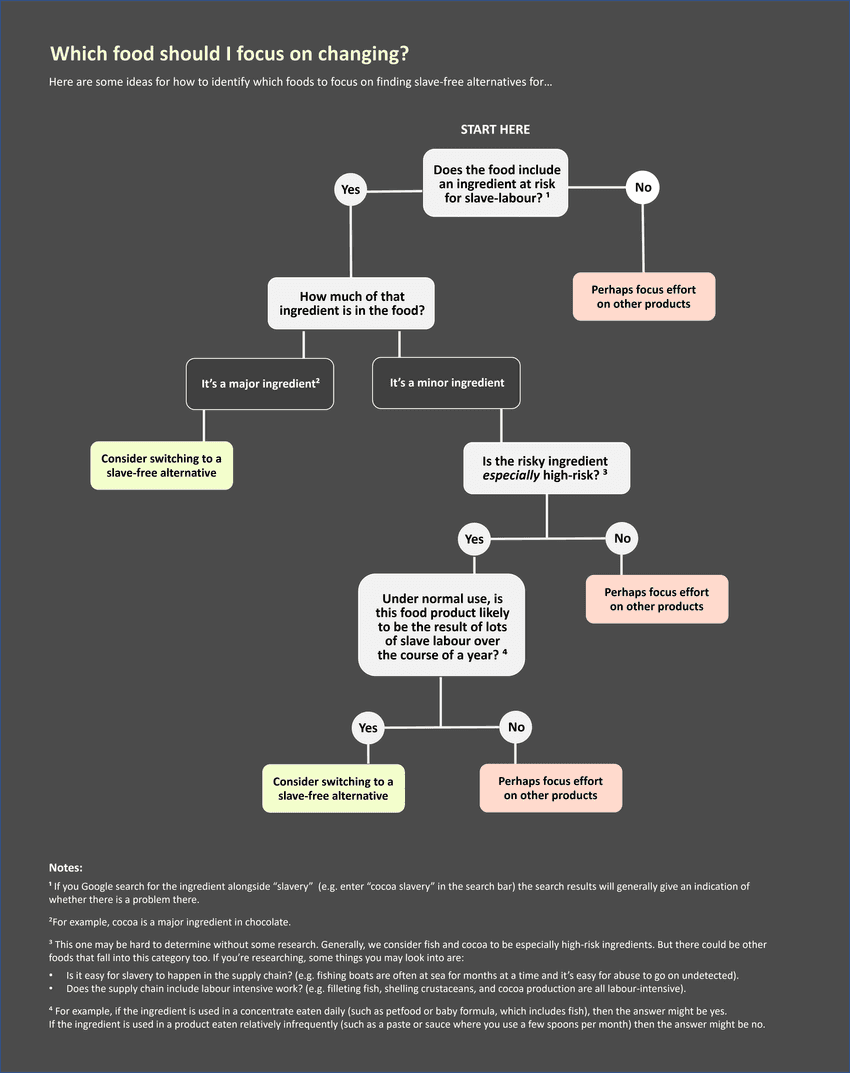
We’ve come up with this set of questions after thinking through the approach for Just Kai’s research. If you’re wanting to identify which food groups to switch to make the greatest impact, we hope this provides a useful starting point.
But we’re only a small team, and perhaps there are other important factors that should be considered in the decision tree too! We’d be keen to hear what you think – do you find this helpful in deciding which items to focus on finding slave-free alternatives for? Is there anything we’ve missed?
Research to make the most difference
The thinking represented in the decision tree above is broadly what shaped Heather and Martin’s food changes for their household. Following those guidelines, Heather started looking into the supply chains of food eaten in her household. She began sharing her findings on her personal blog, and as interest grew, ‘Just Kai’ was born and collects all the research in one place.
But while Heather and Martin’s consumption habits were the starting point for Just Kai’s research, we’d like to look at food products used in the wider New Zealand context – as opposed to just one household! :)
So ideally, we want to focus our research on the highest risk foods that Kiwis use a lot of.
Working out which foods Kiwis use a lot of has largely been guesswork so far – through conversations with friends, or seeing which sections seem to be big in the supermarket and then assuming that means those foods are highly consumed in Kiwi households. Another way to look at this could be financial value (i.e. what value of the product is imported into New Zealand each year). If the food is highly likely to use slave-labour, but not much is imported each year, then probably not many people consume it in New Zealand, and maybe we should focus our research on foods that are lower risk but more widely consumed. We haven’t quite decided yet how to determine which foods are used a lot on a nationwide level, but these are some of the things we’re thinking about!
In terms of what are the highest risk foods, we know that fish, cocoa, and sugar are the categories where slavery is most common. So, these are the areas we’ve focused on so far. However, within these there are a myriad of products. As we come towards the end of our research on the “obvious” items with these ingredients, we’ve been thinking about our next steps…
-
Should we continue to dig deeper into our three current focuses of fish, cocoa, and sugar? For example, we could research further into fish as a category, looking at products where it’s a more minor ingredient (e.g. infant formula) or implicated in supply chains for other foods (e.g. fish meal is high-risk for slave labour, and chickens are often fed on fish meal, so the supply chains for chicken and eggs could include slave-labour).
-
Should we expand into other food categories? Tomatoes, bananas, hazelnuts, cashews, palm oil, etc. are all foods we’ve been alerted to having varying degrees of risk for slave-labour.
Recommendations to make the most difference
We’ve also been grappling with the criteria for what products to include on our list of recommendations. Below are some factors we consider:
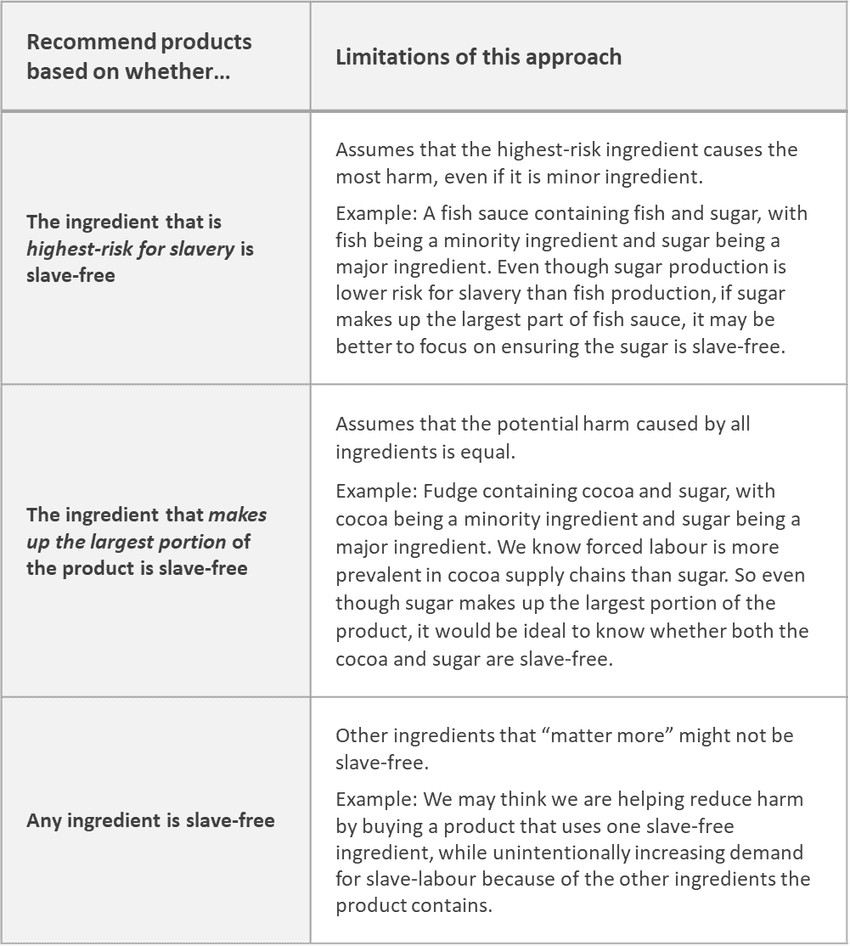
So there’s a few things for us to think about! Let us know if you have any thoughts or ideas on this.