Original research done in Feb/March 2025 as part of research for a Baking guide. Thus far we also have information on baking cocoa and chocolate and sugar.
Want to infuse your home baking with wonderful slave-free vanilla flavours?
This article tells you how! Whether your budget allows for vanilla essence or stretches to the real deal with vanilla extracts or beans, we have you covered. Jump through to our recommendations section or start at the beginning to learn why this is an important issue.
Types of vanilla products

Vanilla comes from an orchid whose pods contain high levels of vanillin.
Vanilla extract = vanillin extracted from vanilla pods + >35% alcohol
Vanilla essence = synthesised vanillin + >35% alcohol
We have found no evidence of worker abuse in the production of vanilla essence, so these products are not discussed below. However there are concerns for vanilla extract.
Keep reading to learn about the issues or use the table of contents below to jump straight to what you’re interested in.
Table of Contents
Issues
Most vanilla products we buy don’t state the origin of the vanilla. However, we know from import statistics that in 2024, Aotearoa/NZ imported vanilla from a range of countries. These include (by Kg) Australia (22%), Madagascar (18%), USA (14%), Uganda (12%), and Papua New Guinea (12%).
While USA and Australia appear to be exporting a lot to NZ and they do grow some vanilla, they may also be “clearing houses” for vanilla from high-risk countries. (There are many administration steps when a grower (or companies buying from the growers) exports food ingredients, so instead of the growers/companies doing all this administration, the clearing house coordinates it, and thus may become listed as the exporter.)
In Uganda and Madagascar forced labour, including child labour has been a reported issue in the vanilla industry for a long time. A US Department of Labour report in 2024 cited evidence of child labour in Madagascar and Uganda and that their governments were only making moderate efforts to address the problems. In both countries, children often help with pollination work on their family farms because of their small, dexterous hands. This work cannot be done after school; it must to be done in the morning to be successful. This leads to high levels of truancy during the pollination period.
Another report states that Madagascan authorities are aware of the child labour problem in vanilla harvesting, but often do not take action because child labour is normalized in vanilla growing regions. It is particularly concerning to find child labour in this field as machetes and sharp knives are used.
How can you identify slave-free vanilla extract and baking products?
Just Kai has looked at all the ethical claims and certifications we were able to find on vanilla extract sold in New Zealand supermarkets, organic and specialty food stores. We’ll look at actual certifications first, then at other options.
Recommended certifications that may apply to vanilla
WFTO
Unlike some other certifications, WFTO doesn’t issue different standards for different commodities. However, you can be confident all WFTO-certified products have involved:
- no forced labour or child labour
- sufficient payment that all workers can receive at least a living wage (calculated for that country or region);
- safe working conditions
WFTO members in Madagascar and Uganda may produce vanilla. However there appear to be no WFTO certified vanilla products in NZ at this stage. Let us know if you come across any!
Fairtrade
All Fairtrade certified products have been subject to audits to check that no child labour or forced labour was used on the farms where they were grown (and any instances found are remediated); there have also been audits to check that various health and safety standards were adhered to. Growers are also paid a premium that is to be used for things that benefit the community and, in some cases, sustainability projects.
In the Fairtrade system there is often a minimum price paid for products – it is set at a level that means the producers earn enough to live and are sometimes called Living income Reference prices. For both Uganda and Madagascar vanilla producers these prices were reviewed by Fairtrade International and reset in 2024.
Fairtrade International accreditation has been granted to some vanilla products throughout the world. There is one readily available product in NZ with Fairtrade certification – Taylor and Colledge 100ml bottles of vanilla bean extract.
Rainforest Alliance
Rainforest Alliance certified products are subject to regular audits to check for child labour and forced labour, and all producers must have remediation processes in place for any cases that are found. Producers are required to be working towards paying a living wage (although there’s no time-frame required for this). There are also various requirements for days off, breaks, health and safety etc. but no requirements for producers to give workers annual leave or sick leave.
Rainforest Alliance and the Union for Ethical BioTrade (UEBT) developed a joint Herbs & Spices Program, which includes vanilla extract. All ingredients certified under this new program will be able to carry the Rainforest Alliance Certified seal. However there appear to be none of these certified vanilla products in NZ. Let us know if you find something in the market we can recommend here!
Other options for vanilla
Sustainable Vanilla Initiative
The Sustainable Vanilla Initiative (SVI) is a voluntary industry initiative, which aims to promote supply of vanilla, produced in a socially, environmentally and economically sustainable way, benefiting all partners along the value chain.
SVI and its members are committed to improving and sustaining vanilla farmers’ incomes and livelihoods. This commitment means investing in strategies to help farmers close the gap between current incomes and a living income.
Examples of this action are described by SVI and include the following:
- In 2015, vanilla exporters in Madagascar signed a Code of Conduct committing to prevent children from engaging in certain types of vanilla work.
- Producers have been reached through training and awareness activities.
- Systems for monitoring and addressing child labor issues have been established
IDH (an organisation working to make agricultural markets more sustainable), said “From 2017 to 2020, the Sustainable Vanilla Initiative (SVI) was active on the ground in addressing Child labour in the Vanilla Sector, through the collaborative project with the International Labor Organization (ILO) called SAVABE.” (From the IDH website.)
In June 2024, SVI in collaboration with Save the Children issued a series of videos in various languages explaining the steps mentioned above to prevent child labour in the Madagascan vanilla industry. There are a mixture of vanilla farmers sharing their stories and other actors along the supply chain showing the work they are engaged in on these video clips.
Taylor & Colledge (already mentioned above) and Dr Oetker Queen (owner of Queen and Hansells brands) are both members of Sustainable Vanilla Initiative. We consider all vanilla products by SVI members to be low risk for child labour.
Vanilla products from the Pacific Islands
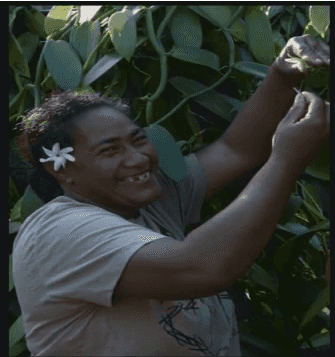
Vanilla products from the Pacific Islands are available in New Zealand supermarkets, independent grocers, and online. There are two brands we have researched: NIUE Vanilla from Niue, and Heilala from Tonga.
With respect to Niue, a 2017 Unicef report concluded “there is no evidence of child labour being an issue in Niue”. A 2023 report by US Department of Labour also concluded there was no evidence of child labour. We also checked the U.S. Department of Labour’s list of goods produced by forced or child labour, and there is no listing for the vanilla arena in Niue, so there is also no evidence of adults being in forced labour.
Based on the above, we recommend NIUE Vanilla products.
With respect to Tonga, there appears to be mixed reports on the risk of child labour. A U.S. Department of Labour 2022 report indicates there is child labour in the agricultural sector in Tonga. It also states that the Tongan government has only made minimal advancements to reduce the risk of child labour. However, an independent 2021 report examining the Tongan vanilla industry, published in the Academy of International Business journal makes no mention of child labour or forced labour in the Tongan vanilla fields (although it’s possible that wasn’t the focus area of the researchers).
Heilala exists as a social enterprise, sourcing vanilla from Tonga and publishing impact reports every year detailing the work they are involved in. This includes supporting children’s schooling and empowerment of women into various jobs. Based on this, we expect Heilala has strong commitments to workers rights and recommend Heilala vanilla products.
Recommended vanilla products
As mentioned above, we expect all artificial vanilla essence to be slave-free. So the following recommendations are just covering vanilla extract products or vanilla beans.
Taylor and Colledge vanilla bean extract
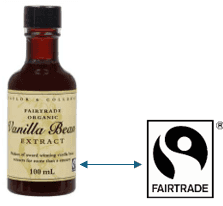
These 100ml bottles are Fairtrade certified. Available in some PakNSave and New World supermarkets for around $10.
Taylor & Colledge pastes
These pastes are produced by Sustainable Vanilla Initiative (SVI) members and are available at New World.
Queen
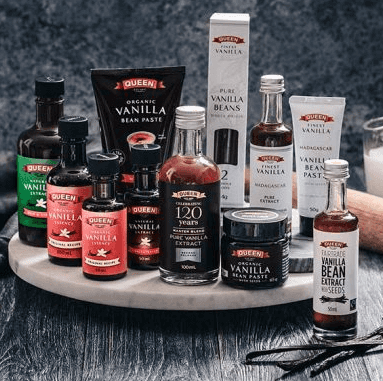
Queen is owned by Dr. Oetker, which is a Sustainable Vanilla Initiative (SVI) member. Queen has a large range of products including extracts, pastes and beans widely available in all the supermarkets.
Hansells
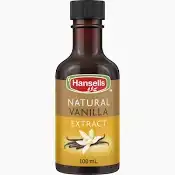
Hansells is also owned by Dr. Oetker, which as noted above is a Sustainable Vanilla Initiative (SVI) member. (Hansells being owned by Dr. Oetker isn’t on any public website, however we know about it from contacting the Technical Manager for Hansells NZ.) The above vanilla extract product is widely available in all the supermarkets.
NIUE Vanilla

Niue Vanilla Organic is a privately owned family business based in Niue. They are in close contact with the growers where there is a low risk of slavery.
They sell a wide range of vanilla products (extracts, pastes and beans) through their online store.
Heilala

Heilala is a privately owned business with an associated social enterprise. In their impact statements you can read about how they are supporting communities through adult employment and providing educational resources for school students. They produce a wide variety of vanilla products including alcohol free extract (a rarity). Available from New World, Woolworths, PaknSave and Farro.
Brands we have insufficient information about to recommend:
Equagold
Also known as ‘Equator Gold’, this company started with vanilla directly from Papua New Guinea. We currently don’t know where it is sourcing its vanilla from. We emailed for more info on 23/01/25 and have had no response yet at time of writing.
Mrs Rogers
Sells vanilla extract and beans, and baking and icing mixes. We couldn’t find any information online about where they source their vanilla from. We emailed for more info on 23/01/25 and have had no response yet at time of writing.
Woolworths
Sells vanilla extract which is a blend of natural vanilla plus flavourings and palm oil. We couldn’t find any info online about the source of the vanilla or palm oil, and both of these ingredients tend to be high-risk for slavery.
At the time of writing we have no information regarding their supply chains for this category of products.
Pams
Pams sell vanilla natural extract, but we couldn’t find any info online saying where the vanilla is from.
On Pams website it says: “With our Modern Slavery Position Statement, we are committed to using the Sedex platform and independent ethical audits to evaluate suppliers and manufacturers of our products, we also require our produce suppliers to engage with their upstream suppliers to ensure that our standards are met at every level of the supply chain.
All Pams suppliers are members of Sedex and have completed a risk assessment. For those identified as being in medium or high-risk categories, we require a social audit to help us ensure fair and safe working conditions. Currently, 88% of high-risk supplier sites have completed this audit, and we’re targeting 100% completion by June 30, 2025.”
We do not know where their vanilla product sits in this system of auditing e.g. whether the Sedex platform indicates it is an area of risk in their supply chain, and if it is, whether social audits have yet been completed.
We contacted Pams for more info on 23/01/25 and have had no response yet at time of writing.